Pound-for-Pound
Pool showdown
The Best Salt Water Chlorinators of 2026 — and the Truth About Whether Salt Is Cheaper
Some links here are affiliate links — if you buy through them, we may earn a commission at no extra cost to you (sometimes with a discount for you). It never changes which products we recommend — and we name the SKIPs to prove it.
- contenders compared
- 7
- owner ratings · Amazon + CircuPool + Jandy
- 1,696
- verified pull-quotes
- 3
- data last verified
- 2026-10-26
Walk into any pool store and you’ll hear the same pitch: switch to salt and you’ll stop buying chlorine, your water will feel like silk, and you’ll save money for years. Two of those three are true. The water really is softer, and you really do stop hauling jugs of chlorine. But “saves money” is the myth the whole category is built on — and almost nobody will show you the math that proves it. So we built the math. The honest answer is that over ten years a salt pool costs about what chlorine does — roughly even with liquid chlorine, and a bit more than cheap trichlor tablets; what you’re actually buying is convenience, consistency, and your weekends back. This is a pound-for-pound guide to the best salt water chlorinators of 2026, built around the one tool no rival publishes: a model-aware calculator that uses each unit’s real replacement-cell economics — the single biggest cost — to settle whether salt is worth it for your pool.
Is a salt pool actually cheaper? Do the 10-year math.
Everyone says salt "saves money." This is the model-aware cost no rival shows: pick your salt system and it pulls in that unit's real replacement-cell economics — the single biggest swing — then compares it against tablet and liquid chlorine over the years, counting the chemicals manual owners waste fighting their own water. The math updates live.
Don't know your gallons? Work it out here →
Exact geometry at 7.48 gal/ft³. Kidney shapes, diving hoppers and salt/turnover figures live in the full Pool Volume Calculator.
Cell cost ÷ lifespan is the salt pool's hidden subscription: $140/yr. A cheap cell (CircuPool's is $699) is what makes salt competitive; a premium OEM cell (Pentair's is ~$1,550) is what makes it expensive. Every cell here assumes about five years (~10,000 hours): no maker on this page publishes a longer rating we can point you to.
The part the "salt costs more" crowd leaves out: without a cell metering chlorine for you, you overshoot and correct — and trichlor tabs slowly poison your water with cyanuric acid until you have to drain and refill to reset it. A salt cell never does either.
Overshoot, algaecide/clarifier you didn't need, extra shock, fighting pH — what a careful owner can drive toward 0% and a busy one pushes past 20%. Applied to the manual chemical spend only.
Now price your time — the real reason most people go salt
Hard dollars usually land close to a wash. What salt really buys is your weekends back: no hauling chlorine jugs, no twice-weekly testing-and-correcting, no green-pool panic. Put a value on the hours and watch it tip. (Defaults to $0 so it never pads the numbers above.)
A salt pool isn't zero effort — you still test weekly and add acid. But manual tabs/liquid run ~30–45 min a week plus the spiral days; salt is closer to 10–15 min. The gap, times your hourly rate, times 10 years, is the convenience dividend. Time cost is added to each total above only when your rate is above $0.
Estimate only — real cost depends on your pool, climate, run-time, water rates, and how disciplined you are. Salt-side = installed system + cell replacement (cost ÷ lifespan) + salt top-ups + muriatic acid (pH climbs in every pool as CO2 escapes, so regular acid is normal care) + the cell's electricity (estimated from your pool size and rate). Tablet & liquid = annual chlorine spend, marked up by your manual-waste %, plus — for tablets only — a yearly partial-drain-and-refill to reset the cyanuric acid that trichlor tabs build up (liquid chlorine adds no CYA, which is its quiet advantage). Pool-store balancing chemicals roughly common to all three are left out because they cancel. Adjust any line below.
Adjust the assumptions
The short version:
🏆 Best overall — CircuPool RJ-45 Plus — 45,000 gal, 1.9 lb/day, a display that reads out your salt level, a 7-year prorated warranty, and no warranty penalty for installing it yourself. It has the deepest owner record of the CircuPool systems (4.5★ / 163 on its own Amazon listing), and owners say the same thing about putting it in: “I installed this in less than an hour,” and “Took all of 30 minutes.”
💰 Best value — CircuPool SJ-45 — the same 1.9 lb/day, the same 45,000-gallon rating and the same $699 replacement cell as the RJ-45 Plus on a $1,095 system, which makes it the cheapest full-size system here to own. The trade: a green-or-red salt light instead of a salt number, a 3-year warranty instead of 7, and no independent owner base yet.
⚙️ Best for a Pentair automation pad — Pentair IntelliChlor Plus40 — the salt system most pros trust and the cleanest match if your pad is already Pentair (40,000 gal, 1.4 lb/day). Two honest catches: its OEM replacement cell is the priciest here (~$1,550), and its owner score is down from 3.6 in July (3.3★ across 176 in October 2026) even though Pentair fixed an early firmware bug (bulletin A00709) on units built after October 2025, so that fix does not explain it.
🛠️ Best for big pools & service — Hayward AquaRite (W3AQR15) — the most-installed salt system in the country, so its T-CELL-15 is on every pool-store shelf and every tech knows it. Rated to 40,000 gallons at 1.45 lb/day, with a mid-priced (~$1,099) cell.
💧 Right-sized & cheaper — CircuPool EDGE-25 — the same 7-year, no-DIY-penalty warranty as the RJ-45 Plus and the cheapest replacement cell on the page ($494), sized to 25,000 gallons for a typical or smaller pool (3.7★ / 47). Buy it if you’d rather match the unit to your pool than oversize.
🛁 Drop-in for spas and tiny pools (early data) — Briidea BR-159 — a no-plumbing cell rated by Briidea to 2,000 gallons, about $180, on 4.4★ / 70: too few ratings to rank. It replaces the Solaxx Saltron Mini, which can no longer be bought on Amazon. Not a system for a real in-ground pool.
⛔ The SKIP: Jandy TruClear — you can’t buy it online, Jandy’s warranty doesn’t cover it if you do, and it makes 0.93 lb of chlorine a day for a pool its rating says can be 35,000 gallons.
The four full-size systems, head to head
| Model | Best for | Max pool size | Chlorine output | Cell life | Cell cost/yr | Price |
|---|---|---|---|---|---|---|
| Best overall | 45,000 gal | 1.9 lb/day | Not published (CircuPool withdrew its 15,000-hr rating in 2026) | ~$140 (cell $699, on a ~5-yr basis) | ~$1,745typical at AmazonCheck price → | |
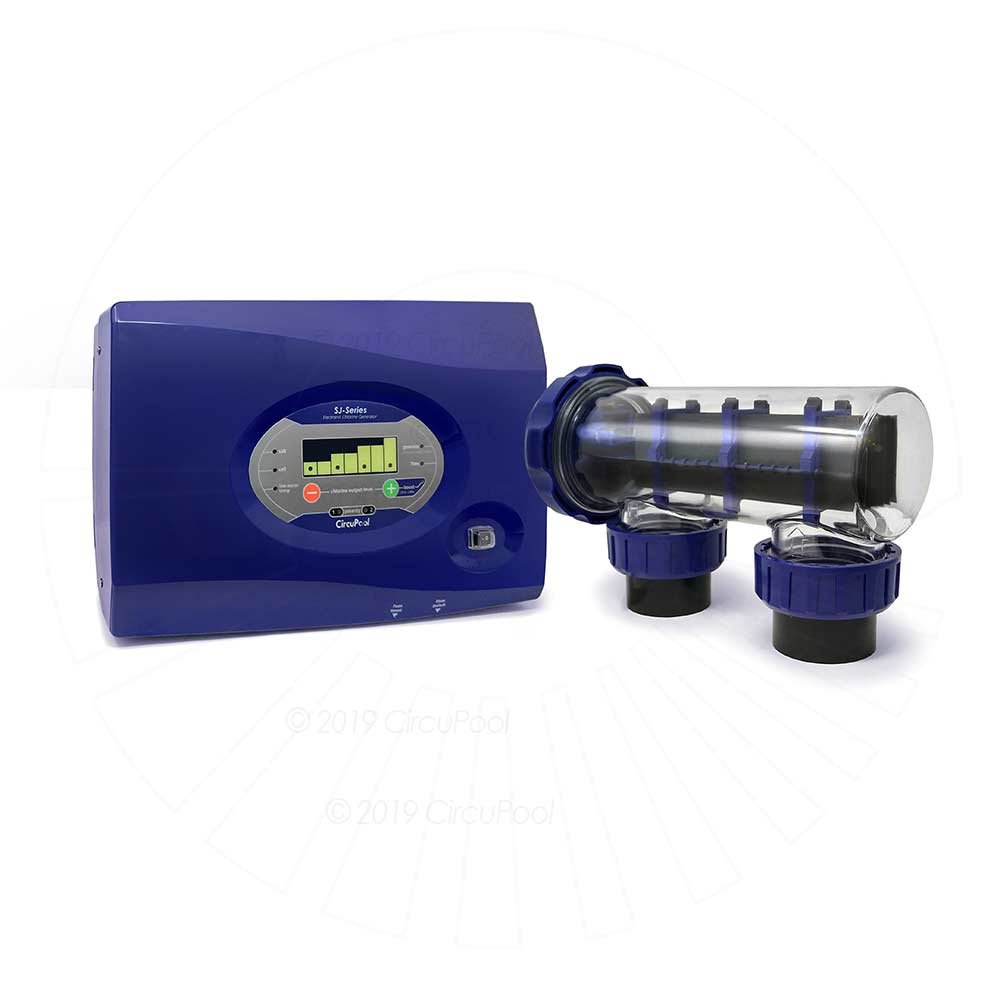 CircuPool SJ-45 Salt Chlorine Generator CircuPool SJ-45 Salt Chlorine Generator | Best value | 45,000 gal | 1.9 lb/day | Not published (CircuPool shows no hours rating) | ~$140 (cell $699, on a ~5-yr basis) | ~$1,095typical at CircuPoolCheck price → |
| Best for a Pentair automation pad | 40,000 gal | 1.4 lb/day | ~10,000 hr (~5 yr) | ~$310 (cell ~$1,550) | ~$1,553.99typical at AmazonIn stockread 2026-10-16Check price → | |
| Best for big pools | 40,000 gal | 1.45 lb/day | ~10,000 hr (~5 yr) | ~$220 (cell ~$1,099) | Check price → |
Prices move constantly — any Amazon price shown is as of the date noted and subject to change; tap through for today's number.
The column that decides it is the last one. Every salt system makes chlorine the same way; what separates them over a decade is the cell cost per year — the replacement cell’s price divided by how long it lasts. That’s where CircuPool pulls away: both of its 45,000-gallon systems use the same $699 cell, about $140 a year over five years, against ~$220 for Hayward’s cell and ~$310 for Pentair’s. We cost every cell on that same five-year life, because CircuPool withdrew the 15,000-hour rating it used to print and no maker on this page publishes a longer figure we can cite. On a ten-year horizon, the cell swings the total by thousands — and it’s the lever the calculator above lets you pull for yourself. We keep the per-model math — cell price, rated life, cost-per-year, and each brand’s DIY-warranty stance — in our Salt Cell Cost Index.
Best overall: CircuPool RJ-45 Plus
CircuPool RJ-45 Plus Salt Chlorine Generator
Best overall · A 45,000-gallon SWG at 1.9 lb a day with an OLED display that reads out your salt level, a 7-year prorated parts warranty, and no warranty penalty for buying online and installing it yourself
Sold in 2 pool sizes on this listing: 45,000 gal, 60,000 gal — this card is the 45,000 gal. Check the size before you add to cart.
Your pick if you want the deepest independent owner record of the CircuPool systems, a 7-year prorated warranty, a display that shows your salt level, and the freedom to self-install. The SJ-45 makes the same chlorine on the same $699 cell for less money, so buy this one for the controls and the warranty, not the cost.
Sold by PACE RESEARCH LTD, shipped by Amazon · read 2026-10-14
Picked before we checked what this link pays us.
Also at: CircuPool
“My RJ45+ has worked as advertised and has been a real blessing to have.”
CircuPool RJ-45 Plus Salt Chlorine Generator
Best overallSold in 2 pool sizes on this listing: 45,000 gal, 60,000 gal — this card is the 45,000 gal. Check the size before you add to cart.
Your pick if you want the deepest independent owner record of the CircuPool systems, a 7-year prorated warranty, a display that shows your salt level, and the freedom to self-install. The SJ-45 makes the same chlorine on the same $699 cell for less money, so buy this one for the controls and the warranty, not the cost.
“My RJ45+ has worked as advertised and has been a real blessing to have.”— Holydoc, Trouble Free Pool · Verified owner
- The deepest independent owner record of the CircuPool systems: 4.5★ across 163 Amazon ratings on its own listing, not shared with the RJ60+
- No DIY-install penalty: buy it online and install it yourself without voiding the 7-year warranty — unlike Pentair and Hayward, which limit or void warranty on online/self-installed units
- A display that shows your actual salt level, where the SJ-45 shows only a green or red light
- Highest output (1.9 lb/day) and biggest capacity (45,000 gal), so it's already oversized for a typical pool — exactly the headroom the 'oversize the cell' rule calls for
- Its recent critical reviews on Amazon describe cells or units quitting inside about two years, and three owners describe a slow or costly warranty claim. CircuPool no longer prints a cell life in hours, so there is no rating to measure that against
- The SJ-45 makes the same 1.9 lb/day on the same $699 replacement cell for $600 less at CircuPool — what the extra money buys is the salt readout and four more years of prorated warranty
- On Amazon it is sold by Pace Research Ltd (Tomball, TX), whose storefront shows 71% positive feedback on 17 ratings; CircuPool sells it direct for $50 less
- Direct-to-consumer brand with a smaller local dealer/installer footprint than Pentair or Hayward — more of the install and troubleshooting falls on you
Cells or whole units quitting inside about two years, and owners describing a slow or costly warranty claim — on the RJ45+ listing itself.
5 of the 10 most recent critical cards (13 in all) describe a cell or unit failing within about two years; 3 of those also describe warranty friction · critical reviews read 2026-10-14
Sold by PACE RESEARCH LTD, shipped by Amazon · read 2026-10-14
Also at: CircuPool
The RJ-45 Plus is the CircuPool to buy if you want the most evidence behind your purchase and the nicest unit to live with. It is the highest-output (1.9 lb/day) and largest-capacity (45,000 gallons) system here, so for a typical pool it’s already oversized the way every pro recommends. Its OLED display reads out your actual salt level, which saves you a test kit every time the salt drifts. It carries a 7-year prorated parts warranty. And it has the deepest owner record of the CircuPool systems: 4.5 stars across 163 ratings on its own Amazon listing, read on October 14, 2026, a base that is not shared with the bigger RJ60+ on the same page. The quiet differentiator is the warranty’s fine print: CircuPool has no DIY-install penalty, so you can buy it online and install it yourself without voiding coverage — exactly the opposite of Pentair and Hayward, which limit or void coverage on online or self-installed units. The honest trade-offs: it’s a direct-to-consumer brand with a smaller local installer footprint, so more of the install and troubleshooting is on you, and a local tech will reach for Hayward parts by reflex.
What it no longer wins is the cost math. This page used to crown it on a cell rated for 15,000 hours. CircuPool has since withdrawn that rating: the figure now sits only in hidden markup on its product page (it was visible as late as January 2026), and the current manual never stated it. Cost on the same five-year life as every other cell, its $699 cell runs about $140 a year — still well under Hayward and Pentair, but no better than the SJ-45 below, which uses the same cell on a system that costs $600 less. So buy the RJ-45 Plus for the salt readout, the longer warranty and the owner record, not because it is cheaper to own.
The honest catch. We read the RJ45+ listing’s recent critical reviews on October 14, 2026: five of the ten most recent describe a cell or the whole unit quitting within about two years, and three describe a slow or costly warranty claim. The owners who post about a salt cell are disproportionately the ones whose cell died, and 80% of its ratings are five stars. But with no hours rating left to measure against, budget for a cell that may not reach five years. On Amazon it is sold by Pace Research Ltd, whose storefront shows 71% positive feedback on 17 ratings; CircuPool sells it direct for $50 less.
Best value: CircuPool SJ-45
CircuPool SJ-45 Salt Chlorine Generator
Best valueYour pick if you want the lowest cost to own a full-size salt system and can live with a salt light instead of a salt number. It matches the RJ-45 Plus on output, capacity and replacement-cell price for $600 less.
- The lowest cost to own of any full-size system here: the same $699 replacement cell as the RJ-45 Plus on a $1,095 system
- Matches the RJ-45 Plus on the numbers that make chlorine: 1.9 lb a day, rated to 45,000 gallons, so it is oversized for a typical pool the way every pro recommends
- CircuPool's manual has no online-purchase or DIY-install clause, the same as the RJ line
- Current second-generation model, in stock at CircuPool
- No independent owner base to check: it isn't sold on Amazon, and the only rating is CircuPool's own (4.8★ across 134 on its product page), which runs rosy by rule
- A 3-year prorated warranty against the RJ-45 Plus's 7 — after year 1 you pay 40% and then 60% of the part price, and nothing after year 3
- LED lights, not a display: you see a green or red salt light, never your salt number, so you need your own salt test
- CircuPool prints no cell life in hours for it (nor for any model now), so the cost math assumes the same five years as every other cell
The SJ-45 is the cheapest way onto this page’s cost math, and it gives up less than its price suggests. It makes the same 1.9 pounds of chlorine a day as the RJ-45 Plus, it is rated to the same 45,000 gallons, and its replacement cell costs exactly what the RJ-45 Plus’s does — on a system CircuPool sells for $1,095, about a third less than its own price for the RJ-45 Plus. With no hours rating published for either cell, that price gap is the whole difference in what the two cost to own, and nothing on the RJ side earns it back: even if both cells fail in year five, the RJ’s longer warranty takes only about $140 off the replacement.
Here is what the extra money buys on the RJ-45 Plus, so you can decide whether you need it. Controls: the SJ-45 shows its output on an LED bar graph and its salt as a light that stays green until salt is too low to run, so you will need your own salt test strips or meter; the RJ-45 Plus shows the number. Warranty: three years on the SJ-45, prorated after the first (you pay 40% of the part price in year two and 60% in year three), against seven on the RJ-45 Plus. Both manuals ask for the same 3,000–4,000 ppm of salt, so running costs are otherwise the same.
The honest catch: there is no independent owner base to check. The SJ-45 isn’t sold on Amazon, and the only rating is CircuPool’s own, 4.8 stars across 134 reviews on its product page — and a maker’s page runs rosy. A retailer listing with 275 reviews turned out to be mostly 2016–2017 reviews of the first-generation SJ line. No credentialed outlet has tested it. We rank it on the specs and the price, which are facts, and we will add an owner quote when a second-generation owner posts one we can verify.
Best for a Pentair automation pad: Pentair IntelliChlor Plus40
Pentair IntelliChlor Plus40 Salt Chlorine Generator (523735)
Best for a Pentair automation padYour pick if your pad is already Pentair and you want the tightest automation integration — the current Plus40 cell (~$1,550). Its cell is the priciest here to feed, and its 3.3★ owner score is down from 3.6 in July even as its base has grown.
“It has worked perfectly with no issues. Very happy with the control panel and how it shows the pool temp and other info.”— Shannon, Amazon · Verified owner
- The current IntelliChlor Plus40 (part 523735) — a drop-in for the now-discontinued IC40, so you're buying the live generation, not old stock
- Integrates natively with Pentair IntelliCenter/EasyTouch automation — the cleanest choice if your pad is already Pentair
- Highest-quality reputation among pros (Swimming Pool Steve names Pentair the top SWG brand) with a nationwide dealer and parts network
- Self-cleaning cell with a clear LED readout of salt level, output %, and cell life
- Its owner score is down from 3.6 in July to 3.3★ across 176, and all ten of the newest critical reviews (2026-09-08 to 2026-10-08) are failures — several on a second or third warranty cell — even though Pentair fixed the early firmware bug (bulletin A00709, units made before Oct 20, 2025) on later units, so that fix does not explain the record and the cause is not established
- The priciest replacement cell here (~$1,550 on Amazon, list $1,819) — and at ~10,000 hr that cell cost is what drives the 10-year total, the single biggest reason a salt pool gets expensive
- Bought online, Pentair's own page gives it one year, parts only — the three years needs a dealer and professional installation — and an older Pentair text still on retailer sites says two years for online IntelliChlor cells. The Amazon seller (Dolce Calma on 2026-10-16) cannot be checked against an authorized-reseller list, and owners in the critical tail report claims refused because the cell came from Amazon
Early failure is the dominant report — units dead within days to three months, several with a sensory-module error the owners say support treats as known. Running alongside it is a warranty problem specific to HOW you buy: multiple owners say a claim was refused or fought because the cell came from Amazon rather than an authorised dealer. One install catch worth knowing before you order: it needs 12 to 18 inches of straight pipe ahead of the cell for flow sensing, which the listing does not mention.
60 written critical reviews (the critical filter's count) as of 2026-10-16; the histogram puts 37% of the 176 ratings at one star. The ten newest critical reviews (2026-09-08 to 2026-10-08) are all early failures, and several describe a second or third replacement cell failing the same way · critical reviews read 2026-10-16
Sold and shipped by Dolce Calma · read 2026-10-16
If your equipment pad already speaks Pentair, this is the salt system that fits it best. The IntelliChlor Plus40 is the current Plus-line cell (part 523735) that replaces the now-discontinued IC40, rated to 40,000 gallons at 1.4 pounds of chlorine a day, and it integrates natively with Pentair’s IntelliCenter and EasyTouch automation — the real reason to choose it over the value pick. Swimming Pool Steve rates Pentair at the top of the SWG heap on build quality and dealer support. But two honest catches keep it out of the overall lead. First, its OEM replacement cell is the priciest here at about $1,550 on Amazon (list $1,819), and since that cell is the salt pool’s real recurring cost, the Plus40 is the most expensive of the three to own over a decade. Second, its owner record: 3.3 stars across 176 Amazon ratings when we re-read it on October 16, 2026, down from 3.6 in July, and all ten of the newest written critical reviews (September 8 to October 8) are failures, several of them on a second or third warranty cell. The early Plus cells did have a firmware bug — units made before October 20, 2025 (firmware 1.003) throw false CHECK CELL and SYS OFF alerts, which Pentair documented in service bulletin A00709 and fixed on later units (firmware 1.004) — but the failures in those newest reviews are on units bought this summer and fall, so the fix does not explain them. We don’t claim to know the cause. Buy it for the Pentair automation link, not on the belief that its reviews are history.
Best for big pools and easy service: Hayward AquaRite (W3AQR15)
Hayward AquaRite (W3AQR15) Salt Chlorine Generator
Best for big poolsYour pick if you want the most-installed salt system, with parts on every pool-store shelf — a proven AquaRite controller for pools up to 40,000 gal; the replacement cell is a real recurring cost and the UX is dated.
- The most common SWG in the US — its T-CELL-15 is the one part every pool store and tech already stocks, so service is never a problem
- Rated to a full 40,000 gallons at 1.45 lb/day output, with the current W3 (NSF-certified) controller revision
- Huge installed base and dealer network; decades of field-proven reliability
- Mid-priced replacement cell (~$1,099) sits between Pentair's OEM cell and CircuPool's value cell
- Replacement cell (~$1,099 every ~5 yr / 10,000 hr) is still a real recurring cost — cheaper than Pentair, well above CircuPool
- Older controller UX and display compared with newer DTC units
- Spec confusion to ignore: the headline output is 1.45 lb/day; the '0.75 lb/day' you'll see quoted is the derated low-salt basis, not a different cell
The pattern owners describe is failure at or just past the warranty line - a cell gone at six months, units not making two years, one reliable for four summers and dead a year after the warranty expired, a flow switch at one year and five days. Several then hit the second problem: getting Hayward to honour a warranty on a unit bought online, which is the channel trap this site documents.
5 of the 10 visible critical cards are a failure at or just past the warranty line and 3 describe a warranty claim going nowhere; all 10 are US and none are Vine. Tail is 89 of 985, and that base pools the 15,000, 25,000 and 40,000-gallon models · critical reviews read August 2026
The Hayward AquaRite is the salt system you see more than any other, and that ubiquity is the whole case for it. Because it’s everywhere, its T-CELL-15 replacement cell is on every pool-store shelf and every local tech already knows the controller — so when something needs service or a part, you’re never hunting. The current W3 (NSF-certified) revision is rated to a full 40,000 gallons and 1.45 pounds of chlorine a day. One spec note worth clearing up: you’ll sometimes see its output quoted as “0.75 lb/day” — that’s the derated figure for a low-salt water condition, not a weaker cell; the headline rating is 1.45. Its replacement cell sits in the middle of this group at about $1,099, cheaper than Pentair’s OEM cell but well above CircuPool’s. The controller’s interface is dated next to the newer DTC units, but for a large pool where parts availability and a tech who knows the system matter more than the last dollar of running cost, the AquaRite is the safe, proven default.
Right-sized for a typical pool: CircuPool EDGE-25
CircuPool EDGE-25 Salt Chlorine Generator
Best for typical & smaller poolsYour pick if you have a typical or smaller pool (up to 25,000 gal) and want a right-sized CircuPool with the 7-year warranty and no DIY penalty; its $494 cell is the cheapest to replace on this page. A big pool wants a 45,000-gallon unit.
- Right-sized for a typical ~20,000-gal pool (rated to 25,000), with the same 7-year warranty as the RJ-45 Plus
- No DIY-install penalty — buy online and self-install without voiding the warranty
- 3.7★ across 47 Amazon ratings, and buyable today
- The cheapest replacement cell on the page at $494 — about $99 a year on the same five-year basis we use for every cell
- Sized for pools up to 25,000 gal — a big pool wants the RJ-45 Plus (45,000) instead
- A quarter of its Amazon ratings (26%) are one star, the heaviest one-star share of the CircuPool systems here — the critical reviews describe units failing early and a warranty with fine print
- Direct-to-consumer brand with a smaller dealer/installer footprint than Pentair or Hayward
- Lower output (1.2 lb/day) than the bigger units — right for a typical pool, not a large one
The RJ-45 Plus is oversized on purpose, but if you’d rather match the unit to your pool, the EDGE-25 is the cheaper, right-sized way to get the same CircuPool value story. It’s rated to 25,000 gallons — plenty for a typical 20,000-gallon pool — and keeps the things that matter: the same 7-year warranty and the same no-DIY-install penalty, for a lower system price ($1,395 as of August 2026). Its replacement cell runs $494 — about $99 a year on the same five-year life, the lowest cell-cost-per-year on this page. It rates 3.7 stars across 47 Amazon ratings (October 26, 2026), and 25% of those are one star — a thinner, weaker record than the RJ-45 Plus’s 163 — but it’s buyable today. The only reason it isn’t the headline pick is headroom: a big pool wants the RJ-45 Plus’s larger cell, and oversizing extends cell life. For a small or average pool that doesn’t need the extra capacity, the EDGE-25 is the smarter spend.
What about the CircuPool RJ-20 Plus?
It exists, it’s current, and we don’t recommend it — so if you came here searching for it, here is the short answer. The RJ-20 Plus is the smallest system in CircuPool’s RJ Plus line: $1,295, rated to 20,000 gallons, 0.9 lb/day of chlorine and the same 7-year warranty (read off CircuPool’s own product page, August 2026).
The problem is what sits next to it. The EDGE-25 above is $100 more and gives you 5,000 more gallons of capacity and a third more chlorine output (1.2 lb/day) with the same warranty. And this page’s own sizing rule cuts the same way: a cell that runs easy lasts longer, so the mistake to avoid is buying just enough capacity. Paying slightly less for a smaller, weaker unit is the wrong side of that trade.
If you specifically want the RJ Plus line rather than the EDGE, skip to the RJ-30 Plus ($1,445, 30,000 gallons) or the RJ-45 Plus we crown above. There is no version of this comparison where the RJ-20 Plus is the right buy for a typical pool, which is why it isn’t carded here.
Drop-in for spas and tiny pools (early data): Briidea BR-159
Briidea Salt Chlorine Generator (BR-159) for Hot Tubs and Swim Spas
Drop-in for spas and tiny pools (early data)Your pick if you want salt in a hot tub, a swim spa or a pool of up to 2,000 gallons with no plumbing, and you accept a young owner record and a one-year warranty.
“I have an inflatable hot tub--- 600 gallons--- and it works! One box of salt has lasted for 3 mos. with the use of this generator.”— Customer SD, Amazon · Verified owner
- A true drop-in: Briidea says "No plumbing needed! Simply plug in the controller above ground while submerging the chlorinator cell in water"
- Sold by Briidea and shipped by Amazon, the only new offer on the listing
- Owners in small tubs report it keeping chlorine up on a short daily run, one on a 300-gallon spa at one hour a day
- Early data: too few ratings to rank it yet, and four of its five written critical reviews are units that died, from five minutes to eight months in
- One owner whose unit stopped at eight months says the seller never answered the warranty claim
- Briidea's earlier drop-in, the HSCG-01, still on Amazon on its own listing, reads 3.3 stars across 102 with 40% at one or two stars; this BR-159 is a different model on its own base
- Briidea publishes no chlorine output and no replacement-cell price, so its cost per year cannot be worked out
- Too small for a real in-ground pool: 2,000 gallons is the ceiling
Units that die. All five written critical reviews (read 2026-10-24): "Worked for about 5 minutes, then overheated and died", "It worked for a week and promptly died", "It malfunctioned straight out of the box", and "Product worked ok for 8 months and then stopped. No response from supplier re warranty." The fifth is about delivery, not the unit. A four-star owner reports a first unit that failed and a second that works.
5 written critical reviews of 36 (2026-10-24); the histogram puts 8% of 70 ratings at one or two stars. 4 of the 5 are a dead unit, 1 delivery. · critical reviews read October 2026
Sold by briidea, shipped by Amazon · Free 30-day refund/replacement · read 2026-10-24
Everything above plumbs inline into your equipment pad. A drop-in is the exception: the controller plugs in above the water, the cell hangs in the tub, and there is no plumbing to cut and no flow sensor to wire. Briidea puts it plainly: “No plumbing needed! Simply plug in the controller above ground while submerging the chlorinator cell in water,” for hot tubs and pools up to 2,000 gallons. That makes it right for a hot tub, a swim spa or a very small pool, and completely undersized for a real in-ground pool.
Why this card changed. Our drop-in pick was the Solaxx Saltron Mini, and it can no longer be bought on Amazon: its listing has read “Currently unavailable. We don’t know when or if this item will be back in stock”, with no offers at all, since at least 16 September, and still did on 24 October. So we searched for its replacement on Amazon five different ways, page two, a most-reviewed sort, a price band and every brand buyers name, and at Home Depot, Lowe’s and Walmart. Only one drop-in had an owner record worth reading: this Briidea, at 4.4 stars across 70 ratings, sold by Briidea at about $180.
Seventy ratings is early data, so read it as that. It is enough to rule out a lemon and not enough to rank, which is why this slot no longer says “best”. Of its 36 written reviews, five are critical, and four of those five are a unit that died: in five minutes, in a week, out of the box, and at eight months, where the owner says the seller never answered the warranty claim. Briidea’s warranty is one year, by its own product page. And its earlier drop-in, the HSCG-01, still sits on its own Amazon listing at 3.3 stars across 102. This BR-159 is a different model with its own base, but that history is the reason to keep the box and the receipt. No testing outlet has reviewed it.
Briidea also sells a WiFi model on the same listing (BR-157), and it is a separate base: 4.3 stars across 76, with 9% at one star. We card the plain one. If you have an above-ground pool of up to ~20,000 gallons rather than a spa, step up to the Solaxx Saltron Retro instead, after reading salt on an above-ground pool, because some above-ground pool warranties are void the day a salt system goes in.
The SKIP: Jandy TruClear
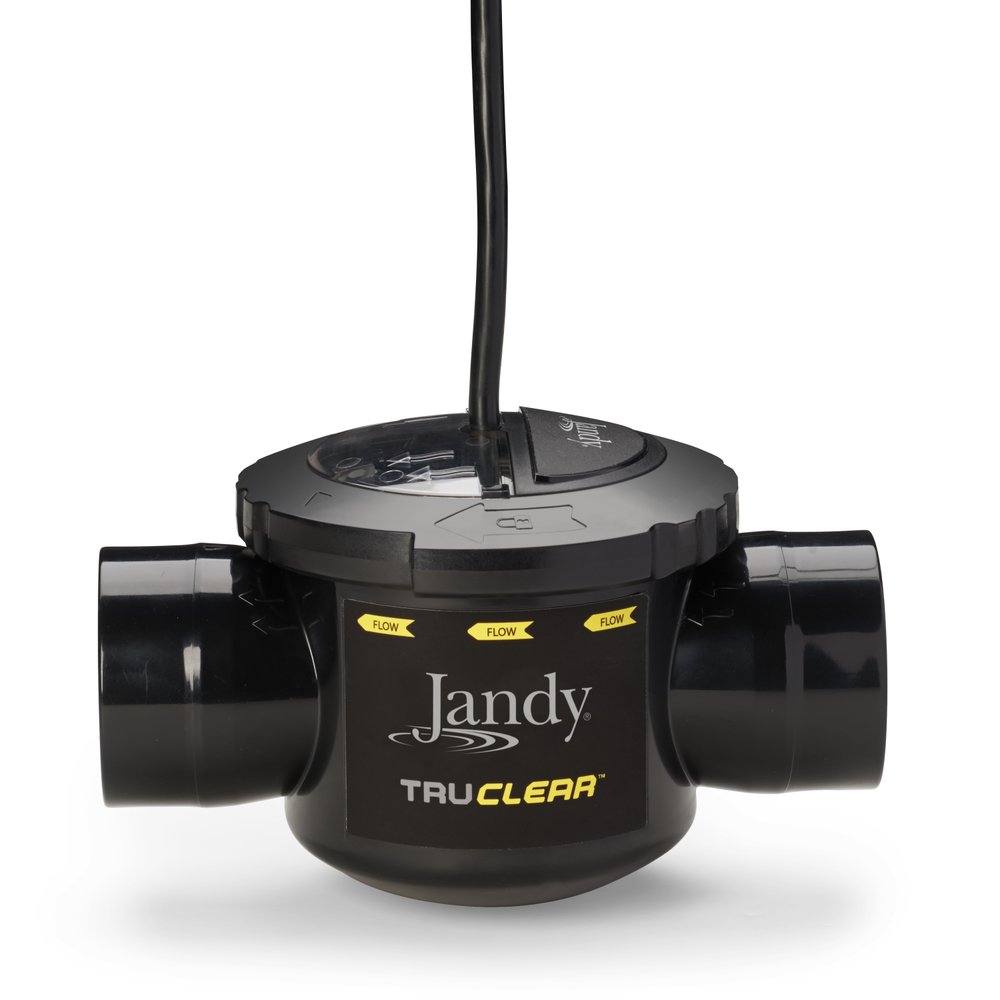
Jandy TruClear Salt Chlorinator (TRUCLEAR11K)
The SKIP: dealer-only, and weak for its ratingYour pick if your pool builder or pool store is already installing Jandy equipment and quotes it as part of the job. Bought any other way it has no warranty, and on a pool near its 35,000-gallon rating it is the weakest cell per gallon on this page.
- Part of Jandy's own equipment line, so a Jandy pad and a Jandy dealer support it end to end
- Dual voltage, and it works with Jandy AquaLink automation and iAquaLink
- Jandy publishes its replacement cell part number (R0693900), so a dealer can source it
- You cannot buy it online: Jandy's page says it 'can not be purchased online', and Jandy's warranty 'does not apply to Jandy branded products purchased through the Internet or other e-commerce platforms'
- 0.93 lb of chlorine a day for a pool 'up to 35,000 gallons' — under half the 1.9 lb a day the CircuPool 45s make for 45,000, so it runs flat out on a pool its rating says it covers
- Jandy publishes no cell life in hours, and the only owner rating is Jandy's own page (4.7★ across 136), which shows no 1- or 2-star reviews at all — a curation tell, not a reliability record
- The warranty requires a licensed or professional installer and pays no labour
If a pool store has quoted you a TruClear, or you searched for one, here is why it is the one salt system on this page we’d steer you away from. Start with how you’d buy it: Jandy’s own product page says it is “available for sale only at your local pool store” and “can not be purchased online”, and Jandy’s warranty “does not apply to Jandy branded products purchased through the Internet or other e-commerce platforms”. That warranty also requires a licensed or professional installer and pays no labour. So the only way to own a covered TruClear is a dealer install at a dealer price, which Jandy’s dealer policy keeps them from advertising.
Then the output. Jandy rates it at 0.93 lb of chlorine a day for pools “up to 35,000 gallons” (its 2020 manual prints 442 grams, about 0.97 lb). The two CircuPool 45s above make 1.9 lb a day for 45,000 — about twice the chlorine for 10,000 more gallons. By this page’s own sizing rule, a TruClear is comfortable on a pool of about half its rating and runs flat out on a pool that matches it, which is how cells wear out early.
The evidence doesn’t help it either. Jandy publishes no cell life in hours, no credentialed outlet has tested it, and the only owner rating is on Jandy’s own page: 4.7 stars across 136 reviews with not a single one- or two-star review among them, which tells you more about the page than the product. If your builder is already putting in a Jandy pad and quotes the TruClear as part of the job, it will make chlorine. Bought any other way, the SJ-45 above makes twice as much on a warranty that doesn’t care where you bought it.
How to choose a salt water chlorinator
Start with the cell, not the brand. Every salt system on this page sanitizes your pool with chlorine it makes from salt — the chemistry is identical. What separates them over the years you’ll own one is the replacement cell: how much it costs and how long it lasts. Divide the cell’s price by its rated life and you get the number that actually drives your long-run cost — about $140 a year for either CircuPool 45, ~$220 for the Hayward, ~$310 for the Pentair. Decide how much you value the dealer network and automation (which is what the premium buys) against the lowest cost of ownership (which the SJ-45 wins), and the pick falls out. The calculator above lets you swap units and watch the ten-year total move.
Size up — oversizing is the one upgrade every pro recommends. Buy a generator rated for more gallons than your pool holds. A cell that’s comfortably oversized runs fewer hours to keep your chlorine where it should be, which means it wears out more slowly and keeps up on the hottest days when chlorine demand spikes. The common rule of thumb is to size the system to roughly double your pool’s volume — for a typical 20,000-gallon pool, that’s a unit rated to 40,000–45,000 gallons, right where both CircuPool 45s, Pentair, and Hayward all land (or the snug-fitting EDGE-25 if you’d rather not oversize).
Under a screen enclosure, everything above gets easier. Sunlight is what destroys free chlorine — Pentair’s own IntelliChlor manual puts it at 90% of unstabilized chlorine lost to UV within two hours, and explicitly lists “screened/unscreened” among the factors that set how long your system needs to run. A Florida birdcage blocks 30–40% of that solar energy (Florida Solar Energy Center testing), so a caged pool burns less chlorine to UV and the cell can hold the same free-chlorine level at a lower output setting or shorter runtime. Since a salt cell’s life is measured in operating hours, that’s not just convenience — it stretches the cell-cost-per-year math this whole page runs on. Trouble Free Pool’s stabilizer guidance agrees from the other direction: “an outdoor pool under a cage or cover does not need as much CYA as an outdoor pool in full sun” — so caged SWG pools can sit at the lower end of the 60–80 ppm range we use for salt pools. (The cell makers’ own manuals, Pentair, CircuPool and Hayward, print 30–50; we run salt pools higher because the cell makes chlorine slowly all day and the extra stabilizer keeps the sun from burning it off.) Nobody publishes a measured output-% reduction for screened pools, so treat the effect as directional: start lower, test (how to test your water — a drop kit, not strips), and let your FC readings set the dial.
Now the bags: buy the salt locally, and buy crystals if you buy softener salt. Whichever unit you pick, it needs 250 lb of salt per 10,000 gallons to reach 3,000 ppm — about 13 forty-pound bags for a 20,000-gallon pool, then one or two a year to replace what splashes out and backwashes away. The cell does not consume salt; it recycles it endlessly, so a rising bill means you are losing water. We priced the identical Morton 40 lb bag in August 2026 at about $8 at Walmart, Tractor Supply, Home Depot and Lowe’s, against $23 delivered on Amazon — 21¢ a pound versus 57¢, or about $195 extra on a first fill. There is no bag online worth the freight on something this heavy and this cheap, so this is one of the few things on this site we will tell you flatly to buy in person.
If you reach for water-softener salt instead — plenty of owners do, and it works — take the crystals, not the pellets. Diamond Crystal publishes the distinction on its own FAQ: its Solar Naturals crystals (the blue bag) are sodium chloride with no additives at about 99.6% pure, while its Bright & Soft and Iron Fighter pellets are high-purity salt that also carries anti-caking and anti-mushing ingredients. Additives are the one thing you are trying to keep out of a cell. Diamond Crystal’s own answer on using the crystals in a pool is yes, with the caveat that they dissolve more slowly than pool salt — which is a brushing job, not a problem.
Go in with honest expectations. Salt makes pool care easier, not effortless, and it isn’t the money saver the showroom implies. You’ll still test the water, you’ll add muriatic acid regularly because pH climbs in every pool as carbon dioxide escapes, and every few years you’ll replace the cell. What you get in return is steady, hands-off chlorine, softer-feeling water, and no more hauling and dosing jugs — which, once you price your own time, is usually the real reason to switch. Run your pool’s numbers in the calculator, decide whether the convenience is worth paying about what chlorine costs, and pick the unit whose cell economics match how long you plan to keep the pool. While you’re optimizing the pad, the other big running-cost lever is the pump — see our guide to the best variable-speed pool pumps.
FAQ
Is a salt water pool actually cheaper than a chlorine pool?
Usually not — and this is the myth the whole category sells. Once you count the replacement cell (the salt cell wears out every ~3–7 years and costs about $500–1,600 to replace), salt top-ups, the muriatic acid a salt pool needs as its pH climbs, and the cell's electricity, a salt pool over 10 years costs about the same as liquid chlorine and a bit more than cheap trichlor tablets. The biggest swing is the cell: a cheap cell like the $699 one CircuPool uses in both the SJ-45 and the RJ-45 Plus can make salt genuinely competitive, while a premium OEM cell costing more than twice as much makes it the more expensive option. The honest takeaway: you don't switch to salt to save money — you switch for softer water and automatic, hands-off dosing. Run your own numbers in the calculator above.
Is salt water chlorine? Are salt pools chlorine-free?
Salt pools are not chlorine-free — they are chlorine pools that make their own chlorine. A salt chlorine generator (also called a salt cell or SWG) runs the dissolved salt in your water through an electrified cell, which splits it into the exact same free chlorine you'd otherwise add by hand. So 'salt vs chlorine' is really 'make chlorine automatically vs add chlorine manually.' The water feels softer and smells less harsh because the chlorine is generated steadily at a low level instead of dumped in, but it's sanitized by chlorine either way.
How long does a salt cell last, and how much does a replacement cost?
Most salt cells are rated around 10,000 hours of run time, which works out to roughly 3 to 7 years depending on how many hours a day your system runs. The cell is the consumable part — it's the salt pool's real running cost. Replacement cells run about $1,550 for a Pentair IntelliChlor, around $1,099 for a Hayward T-CELL-15, and $699 for the CircuPool SJ-45 or RJ-45 Plus. CircuPool used to rate its cells at 15,000 hours but withdrew that figure in 2026, so we cost every cell on the same five-year basis. Because the cell is the cost that matters, compare salt systems on cell-cost-per-year, not sticker price — that's exactly what the calculator above does.
What's the best salt water chlorinator?
For most people it's the CircuPool RJ-45 Plus — 4.5 stars across 163 Amazon ratings on its own listing, a display that shows your actual salt level, a 7-year prorated warranty, and unlike the dealer brands it doesn't void its warranty when you buy online and install it yourself. If cost is what decides it, the CircuPool SJ-45 makes the same 1.9 lb of chlorine a day on the same replacement cell for $600 less; you give up the salt readout and four years of warranty, and it has no independent owner base yet. The Pentair IntelliChlor Plus40 is the pick if your pad is already Pentair and you want the tightest automation integration (its owner score is 3.3 stars on Amazon, down from 3.6 in July, even though Pentair fixed an early firmware bug, so buy it for the automation link rather than the reviews). The Hayward AquaRite (W3AQR15) has the biggest dealer and parts network, the safe default on a large pool. For a typical or smaller pool, the CircuPool EDGE-25 is the right-sized, cheaper sibling; for a hot tub or very small above-ground pool, a drop-in is the cheapest way into salt — the Briidea BR-159 is the one we card, on early data, because the Solaxx Saltron Mini can no longer be bought on Amazon.
Do salt water pools still need other chemicals?
Yes — automating chlorine doesn't automate everything. The big one is pH: it climbs in a salt pool just as it does in any pool, mostly because dissolved carbon dioxide keeps escaping through the surface, plus possibly some chlorine gas escaping the cell before it dissolves, so a salt pool needs regular muriatic acid to bring it back down (lowering alkalinity is what slows the climb) (budget roughly $80–120 a year). You'll also keep an eye on alkalinity, cyanuric acid (stabilizer), and calcium hardness, and you'll add salt occasionally as rain and splash-out dilute it. A salt pool is lower-effort than hauling and dosing chlorine by hand, but it isn't no-effort.
What size salt chlorinator do I need?
Buy a generator rated for more gallons than your pool actually holds — oversizing is the one upgrade every pro recommends. A cell sized well above your volume runs fewer hours to keep up, which means it lasts longer before it wears out and keeps making enough chlorine on the hottest days when demand spikes. A common rule of thumb is to size the system to roughly double your pool's volume. For a typical 20,000-gallon pool, a unit rated to 40,000–45,000 gallons (like the CircuPool RJ-45 Plus or SJ-45, Pentair Plus40, or Hayward W3AQR15) gives you that headroom; if you'd rather size closer to your pool, the CircuPool EDGE-25 (25,000 gal) is the right-sized value option.
Does a screen enclosure change how a salt chlorinator runs?
Yes, in your favor. Sunlight is what destroys free chlorine — Pentair's IntelliChlor manual states 90% of unstabilized chlorine is lost to UV within two hours, and lists 'screened/unscreened' among the factors that set system run time. A Florida pool cage blocks 30–40% of solar energy (Florida Solar Energy Center testing), so a screened pool loses less chlorine to the sun and the cell can hold the same level at a lower output or shorter runtime. A cell wears out by the hour it runs, so running less stretches the cell-cost-per-year math. Stabilizer follows the same logic — per Trouble Free Pool, a pool under a cage or cover needs less CYA than one in full sun, so caged salt pools can sit at the lower end of the usual SWG range. No one publishes exact numbers for screened pools, so start low and let your free-chlorine tests set the dial.
Will salt water corrode my aluminum screen enclosure?
The research says the fear is mostly aimed at the wrong culprit. Corrosion studies commissioned in the 1980s (Case Western's Prof. Robert Hehemann for ELTECH — note, an industry-funded study of stainless equipment) found dissolved salt below 3,000 ppm had an insignificant effect, while high free chlorine was the real corrosion driver — and cyanuric acid actually inhibits it. A residential salt pool runs right around that 3,000 ppm mark, about a tenth of seawater. The honest caveat for the cage itself: that research covered equipment in the water, not aluminum framing, and splash-out that dries on frames and fasteners leaves concentrated salt behind. No measured study of cage corrosion exists either way — so do what enclosure pros recommend regardless of pool type: hose down the lower rails and fasteners with fresh water now and then, and keep your chlorine in range. That combination addresses both the documented risk (chlorine) and the theoretical one (dried splash).
Are trichlor tablets bad for a pool? What is the CYA problem?
Trichlor tablets are convenient and cheap, but they have a hidden cost: they're about 57% cyanuric acid (CYA) by weight, so every tablet permanently raises your stabilizer level. Over a season of tablets, CYA climbs from the ideal 30–50 ppm toward 80–100+ ppm, and once it's that high your chlorine gets 'locked' — you have to run a higher chlorine level just to keep the same sanitizing power, and eventually drain and refill part of the pool to reset it. Liquid chlorine adds no CYA, which is its quiet advantage. A salt cell adds none either — one reason salt's chemistry is steadier than a tablet routine. The calculator above counts that drain-and-refill cost on the tablet side.
Update history
- October 2026 (2026-10-24) — Replaced the drop-in pick. The Solaxx Saltron Mini has been unbuyable on Amazon since at least 16 September ("Currently unavailable", no offers, re-read 24 October), so it leaves the page. We searched Amazon five ways plus page two, a most-reviewed sort, a price band and each named brand, and Home Depot, Lowe's and Walmart: the only drop-in with a real owner record is the Briidea BR-159, 4.4 stars across 70 ratings at $179.99, which is too few to rank, so it is carded as early data and not called best. No hands-on test of it exists; CPSC shows no Briidea recall.
- October 2026 (2026-10-16) — Pentair IntelliChlor Plus40 re-read during the IC40 replacement-cell audit: 3.3 stars across 176 (was 3.2 across 157) and about $1,550 on Amazon (was about $1,590), so its cell works out to about $310 a year on the same five-year life, not $320. Its newest critical reviews are all failures on units bought this year; the 'keeps going down' line is replaced with what the reviews show.
- 2026-10-14 — CircuPool no longer publishes a cell life in hours. The 15,000-hour rating this page crowned the RJ-45 Plus on now sits only in hidden page markup (it was visible as late as January 2026), and the current manuals never stated it, so every cell is now costed on one five-year basis and the RJ-45 Plus's cell cost moves from about $100 to about $140 a year. The lowest-cost claim passes to the newly carded CircuPool SJ-45, best value: the same 1.9 lb a day and the same $699 replacement cell on a $1,095 system. The RJ-45 Plus stays best overall on its owner record (4.5 stars across 163 Amazon ratings, re-read today on its own listing, which sells the RJ45+ again), its salt readout and its 7-year warranty. Added the Jandy TruClear as the SKIP: sold only through pool stores, with a warranty that excludes online purchases. The calculator now defaults to the SJ-45 and its stats were recomputed.
- 2026-10-05 — Salt-pool CYA is now stated as one range, 60–80 ppm (was the 70–80 Trouble Free Pool sweet spot), in line with the site's CYA ruling, with a note that the cell makers' own manuals print 30–50 and why we run salt pools higher. No pick changed.
- 2026-09-18 — Corrected why a salt pool's pH climbs. The FAQ and the pH note said the cell is pH-neutral and the rise is all carbon dioxide leaving the surface. Richard Falk's 2008 retraction of the hydrogen-bubble theory actually moved to a different cell mechanism, chlorine gas escaping before it dissolves, so the page now says most of the rise is CO2 and the cell's share, if any, is that unproven chlorine-gas effect. No pick changed.
- September 2026 — Corrected the Solaxx Saltron Mini's capacity to the maker's own figures: 600 gallons of spa water and 1,500 of swim-spa water in its manual, 2,000 of pool water on its product page. We had published 2,000 as its swim-spa rating, a figure from the Amazon listing title.
- September 2026 — Corrected the CircuPool RJ-45 Plus chlorine output from 2.0 to 1.9 lb a day, the figure on CircuPool's own product page; it is still the highest output on this page.
- August 2026 — Priced the salt itself rather than repeating a range. It takes 250 lb per 10,000 gallons to reach 3,000 ppm (the widely cited 200 lb figure lands at only ~2,400 ppm), and the identical Morton 40 lb bag is about $8 at Walmart, Tractor Supply, Home Depot and Lowe's against $22.85 delivered on Amazon — about $195 extra on a 20,000-gallon first fill, so the guidance is now an explicit buy-it-locally refusal with no affiliate link. Added the water-softener substitution rule from Diamond Crystal's own FAQ: CRYSTALS (no additives, ~99.6% pure) yes, PELLETS no (they carry anti-caking and anti-mushing ingredients). The cost calculator's salt-fill and top-up defaults now derive from that dose and that bag price instead of being flat literals.
- July 2026 — Added the screen-enclosure factor (deep-research sourced): a cage cuts UV chlorine loss (FSEC 30–40% solar blockage; Pentair's manual lists screened/unscreened as a run-time factor) so caged pools run the cell lower and stretch cell-cost-per-year; TFP-verbatim CYA note; plus the salt-vs-aluminum-cage corrosion FAQ (Hehemann/ELTECH: salt <3,000 ppm insignificant, high chlorine is the real driver — attributed as industry-funded, equipment-scope caveats stated).
- June 2026 — First published. CircuPool RJ-45 Plus best overall / best value (lowest cost of ownership, 4.5★/341, 50%-longer cell, no DIY warranty penalty); Pentair IntelliChlor Plus40 best for a Pentair automation pad (with the A00709 early-firmware caveat — buy through a dealer to check the manufacture date); Hayward AquaRite W3AQR15 best for big pools / service; CircuPool EDGE-25 the right-sized cheaper pick for typical & smaller pools; Solaxx Saltron Mini best drop-in for spas. Added the model-aware salt-vs-chlorine cost calculator with the wasted-chemical (CYA + overdose) tax and an optional time-value layer.
Every Water Quality showdown, by division
Same fight, different budgets. The head rulings first, then each weight class as the price climbs.
- CatchweightThe Best Hayward TurboCell Replacement Salt Cell (2026): Which Size — and Is Genuine Worth It?
- CatchweightThe Best Jandy AquaPure Replacement Cell (2026): Why Aftermarket Is a Trap
- CatchweightThe Best Pentair IntelliChlor IC40 Replacement Cell (2026): Aftermarket vs OEM
- CatchweightThe Best Salt Water Systems for Above-Ground Pools (2026): A Two-Season Appliance, Ranked Honestly
 Catchweight
The Best Pool Water Levelers of 2026, and Why Every One Can Stick Open
Five portable pool water levelers compared in October 2026 on their owner record, what each mak…
 Heavyweight · $1,400–$1,600
The Best Self-Docking Pool Robots (2026): WYBOT S2 Solar vs S2 Solar Vision vs Aiper Scuba X1 Pro Max
The Heavyweight class, $1,500–$2,000 at list price, read signed in on Amazon and on each maker'…
 Catchweight
The Best Pool Basketball Hoops of 2026: Matched to Your Pool and Deck
Nine pool basketball hoops read one listing at a time, with every recent critical review. The D…
 Lightweight · $16–$69
The Best Halloween Pool Floats of 2026: Float a Pumpkin, Not a Coffin
Halloween pool floats, read one listing at a time with every recent critical review. FUNBOY's l…